Easter Mosaic.
Easter in Abu Dhabi is like a mosaic.
For some, it is a cultural occasion to gather; for others, it is a quiet family day, a day of faith and church services. And all of this does not exclude each other - in fact, it coexists in a surprisignly harmonious way.
When you are surrounded by different cultures, climate, and rhythm of life, traditions become a choice rather than a default. They no longer live in the background of your surroundings but become a conscious act. In such an environment, you begin to feel more sharply: what in this holiday is mine, what can I bring from others, and what do I leave out. Especially now, when even within the same faith, church leaders are causing divisions and reshaping communities.
In this context, traditions stop being a demonstration - they become a personal space, something uniquely my own. I don’t find myself missing childhood or home, nor do I feel a loss when it comes to Easter. Rather, I sense how it is growing and evolving within me.
There used to be painted eggs, Easter cakes with sugary icing, the morning church service, and the festive table. I did not choose these traditions - they simply were. The holiday was like the air around us. But now, I am among other people, other religions, other rituals. And in this context, I begin to see my own tradition more clearly - what is essential about it? What remains, even when all the external trappings are gone?
It turns out, a lot: the desire to set apart a day, to make it special. To prepare. To decorate. To honor something greater than just a day on the calendar. And it is clear that this desire is universal: in different religions, cultures, and languages.
As it happens that we’re all scattered far apart. My parents are in the same time zone, with their familiar painted eggs, aspic, and quiet family conversations. My sister and niece are on the other side of the world, celebrating with bright Easter cakes, spicy scents, and childlike joy.
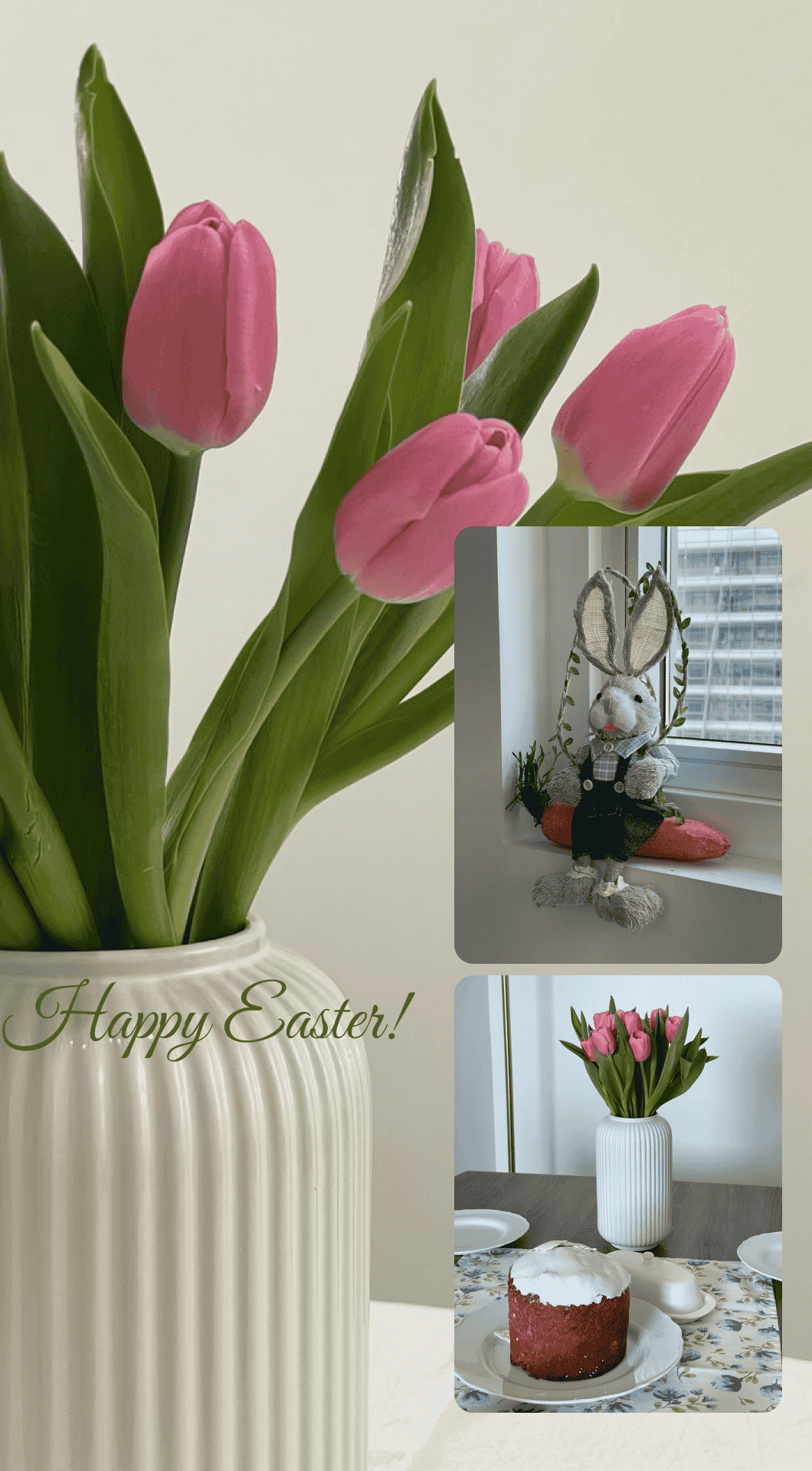
And me? I baked my own Easter cake—using sourdough. The festive table will be foreign, but generous: we’ve booked an Easter brunch at a restaurant, as is common here. Many places offer special menus for such holidays—beautifully set tables, egg-shaped desserts, chocolate bunnies, and well-dressed guests. It’s a very different way of "celebrating," but even in this, you can still feel something in common—the striving toward light, for spring, for celebration.
In this worldly, international setting the holiday becomes less of a duty and more of an invitation — to beauty, to connection, a moments of attention. Some come for eggs Benedict, others to meet friends, others still because it’s Easter. And all of this forms part of one mosaic.
And despite the time zones, distances, languages, and even different degrees of "feeling the holiday," there is something that connects us on this day. I think about this as I pull my Easter cake from the oven, and I realize: the holiday hasn’t disappeared. It’s simply changed form. It lives in these small gestures: someone bakes, someone dyes eggs, someone just sends a message.
We hold onto the same invisible center.